Explore Sarasota’s rental market in 2025—pricing trends, new communities, and exclusive move-in specials. Find your next home with expert insights.Explore Sarasota’s rental market in 2025—pricing trends, new communities, and exclusive move-in specials. Find your next home with expert insights.
Sarasota Rental Market Overview
Sarasota’s rental scene is evolving. With average prices stabilizing and new developments offering generous incentives, renters have more choices than ever. Whether you’re relocating, downsizing, or seeking a seasonal escape, Sarasota offers a mix of luxury, affordability, and lifestyle.
Timing matters: Incentives often expire quickly—act fast
Hidden fees: Ask about pet deposits, parking, and amenity charges
Lease flexibility: Some offer short-term or month-to-month options
📣 Ready to Rent in Sarasota?
Sarasota’s rental market in 2025 is full of opportunity. From beachside apartments to golf course condos, there’s something for every lifestyle and budget. Let me help you find the perfect place to call home.
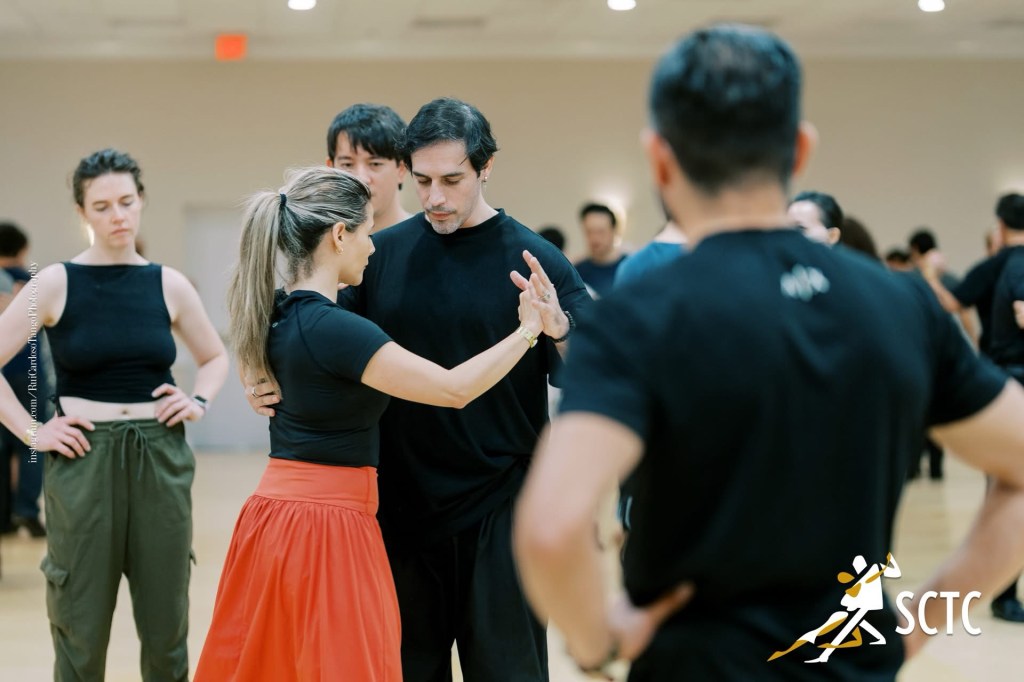
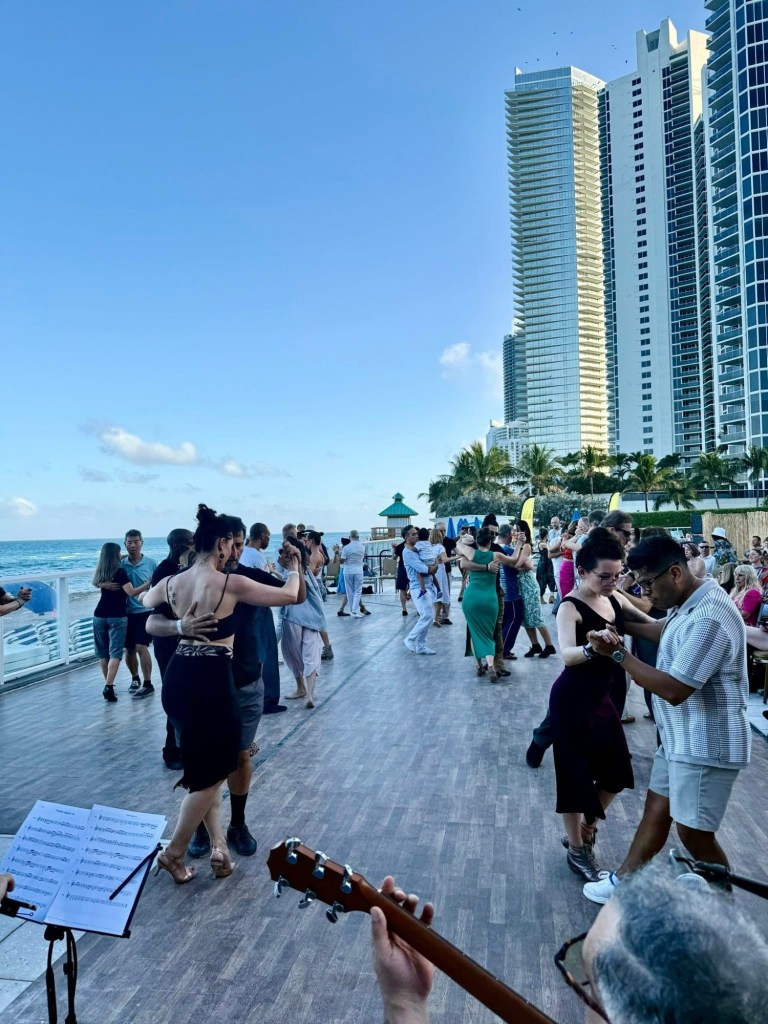
Flight into the unknown in SoCal (Southern California Tango Championship & Festival). My first tango festival, my first competition, my first time in California, USA. I’d never competed in tango. I hadn’t even been dancing for a year. But something inside me told me I had to go. That this experience had something in store for me.
Yes, I competed. I dared. But I did so out of ignorance. I apologize—to the judges, the teachers, my classmates—because I didn’t know what I was doing… at least not until I arrived in SoCal.
It all started two weeks earlier. Wook, a Korean guy I’d danced a couple of tandas with in Sarasota, wrote me on Facebook: “Do you want to compete with me at a festival in the Amateur Floor Tango category?”
I, who understood “amateur” as “beginner,” said yes almost without thinking. There were only two days left to register. While I tried to get tickets, he took care of everything else.
After buying the ticket, I started asking around. I wrote to Guada and Junior Cervilla, two of the best tango dancers I know, who organize a milonga once a month in Sarasota, which was my first milonga (which, by the way, I attended for the first time after only three classes… I’m ashamed to admit it).
Guada replied: “The level there is high. It’s not like here. Those who are going to the World Cup go. But enjoy it, it’s going to be a great experience. You’ll like it.”
And that’s when I realized that, once again, I had jumped out of the plane without asking if there was a parachute. But as I always say: my greatest fear is over, and I have little to no fear of ridicule.
During those two weeks before the festival, I was only able to dance with my partner about five more times. Wook had suggested I dance with him because his wife’s mother had gotten sick, and now she had to take care of her and couldn’t travel. Wook decided to look for someone to compete with in the amateur tango category. I suppose he wrote to several people beforehand, but he just happened upon me—the one who said yes without much hesitation.
During our conversation, he explained his family situation to me and also said something that touched me deeply: “I’m almost 55 years old, this could be my first and maybe my last chance to compete.”
That convinced me. There was nothing more to say. I bought the tickets and set off on the adventure.
Days before the festival, Wook fell ill. We weren’t able to practice as much as we would have liked, and yet, against all odds, we made it to the semifinals. But I knew—I felt it—that the judges could see when there was no connection with your dance partner. There was a lack of communication and synchronicity. After the California Tango Festival, I took the time to listen to my partner more closely. We came from completely different worlds.
In the eyes of the experts, he sacrificed the embrace for the sake of the move. But for him, that close embrace, which seemed warm and necessary to me, was in itself an enormous act of disrespect toward his wife. A cultural sacrifice. And how can I explain tango to him? They are words he doesn’t understand, foreign sounds, a completely different phonetic.
He writes in figures that are indecipherable to me, and I’m no different to him. If it weren’t for English, we wouldn’t be able to hold a conversation. And when he speaks in his own language, it sounds strange and inharmonious to my ear.
Even so, we made it far. And we’re proud. We’re probably not cut out to dance tango together, but I’m truly grateful to you for inviting me to this madness. It was, without a doubt, one of the most enriching experiences of my life. Tango, though fragile, built a bridge between two worlds.
Crossing to the other side
To get to the event, you had to cross a path that connected the two hotels: my standard one—comfortable, yes, but unpretentious—and the Hilton where the SoCal Tango Festival California was being held. As I walked toward it, the atmosphere began to transform. The path was beautiful, almost ceremonial. You felt like you were entering another world: more elegant, more vibrant, more alive.
As soon as I set foot inside the Hilton, I felt it. Everything was different. In the background, a sign announced the Tango California festival. I had to walk a few more steps, turn right, then left… and there it was: the heart of the event.
The registration tables. There they handed out bracelets, sold individual tickets for classes or milongas, and you could feel the energy of those who had made all this possible. It was there that I met Dionisio, the cameraman. As usual, a little lost, I looked at him, not knowing where to go. Without hesitation, he asked me if I needed help. I told him yes, that I had just arrived. “Are you coming for the festival?” he asked. When I said yes, he smiled at me with a very special warmth: “I’ll take you.” He walked me to the table, and finally, I received my bracelet.
I’d made sure to buy the full ticket. I wanted to experience it all. I didn’t come to see what was happening. I came to be involved in everything.
That first day, after settling in, I went shopping with my partner. We went to a Korean supermarket—a very special experience because he’s Korean too—and I discovered completely new flavors, textures, and smells. It was, oddly, the only thing I saw of Irvine, because outside of the festival, I didn’t explore anything else. I just came to the event. It was my first time in California, my first time at a tango festival, my first time in a competition… and also, my first year dancing tango! Everything was a first.
My first class was with Manuela Rossi and Juan Malizia, stage tango specialists. They’re brilliant. I took two classes with them that day. I was lost, of course, not knowing what to do next or where to go. During one of those breaks, my partner had to go compete, leaving me alone in one of the rooms… That’s when Clarisa Aragón arrived.
I took a class just for followers, for girls. I loved it. Although I often had to do the exercises alone because there weren’t enough of us to pair up, I thoroughly enjoyed it. In that class, I also met Chris, part of the staff. He noticed me, we connected. I think my dedication caught his attention. From then on, we started talking. It was lovely. I began to form real bonds with people who, until then, had been complete strangers.
Clarissa’s class was special. She’s an angel, a sweetness… a way of teaching that envelops you.
That night, I supported my partner, Wook, and also Andrés Bravo and Carolina Balmaseda, who I already knew would be competing. My heart has been with them for a long time; I admire them. But my heart also went out to Jael Mantilla and Jesús Aranguren, two guys I had met just eight days before the event because Wook had hired them for two hours to help us prepare for the competition… and I ended up sharing a room with Jael. I experienced the festival from many angles: as an apprentice, as a naive competitor, as a friend of a professional who lived it all with passion.
What I didn’t know was that this trip would mark a before and after, not only in my dance, but in my way of inhabiting art…
Competing without connection (cultural or musical)
How did I survive an amateur tango competition with a Korean partner who didn’t speak a common language?
We barely knew each other; we didn’t speak the same language. We had different musical backgrounds, different body styles. And yet… We made it to the semifinals. Against all odds.
My mind began writing this from the moment I arrived at the event. I’m aware that, at some point, or perhaps there’s already a meme circulating about my reaction when, leaving our hair on the fence (as we say in my country), my partner and I made it to the semifinals. I couldn’t believe it… That’s me while I was dancing and experiencing the festival, writing chapters, paragraphs, and even pages of stories, reflections, and questions to myself, which I then answered. And not just in tango; this is, if you haven’t noticed yet, deeper than a simple description of the festival.
I thought about my dad, about my life, about how our egos play tricks on us, even if only for a few seconds, and we don’t realize how hurt we are. I felt and reflected on how imperfect I am. During a class, on the day of the semifinal, I got frustrated with Wook during the musicality class, taught by Clarisa Aragón and Jonathan Saavedra. Since we both heard music so differently, we clashed. Minutes after the class ended, Clarisa, with that charisma and special gaze, approached him and explained something. It was just the moment we had to leave. I left the room and boom! My knee hurt, not the one that always hurts, but the one that’s supposed to be better. In the midst of that frustration, not knowing how to communicate with my partner harmoniously and as a team, I stopped outside the room—the same one where we would dance later—drank some water, and asked myself: Why does my knee hurt? And the answer was clear: that’s ego, Sara. We have to subdue our ego and understand that we’re different. Maybe, in the midst of my reflections, my faces were funny, but I had moments when I seemed to be staring into space when in reality I was writing in my mind, capturing inspiration, and photographing images that are now translated into words.
To summarize that reflection: my knee, as if by magic, stopped hurting. Maybe my ego kicked in. Did I want to leave my partner and not show up with him because it wasn’t what I wanted? Fortunately, I reflected, apologized, and we moved on.
That’s how I began to understand how the body and music combine and become art. But on the night of the semifinal, the same night we obviously didn’t make it to the final, my ego once again told me, “Why not?” But I had to say, “You’re not up to it.” There are no improvised partnerships here. That’s how tango works: if there’s no communication and connection with your partner—you’re not on the same wavelength—the message isn’t transmitted clearly. And that was obvious between my partner and me, so the surprise of not making it to the next round wasn’t so great.
What I understood at that moment was that connecting in tango isn’t just about synchronizing with the music, but also with your partner. Sometimes I managed to sync with my leader’s musicality, either because I understood the instruments he was following or because he, being more experienced, adjusted his cue to make me feel right. But often, despite being perfectly synchronized with the music, something was missing—a missing tango.
Sometimes the heart wants to dance, but the body doesn’t respond. It was a lesson in humility. Art isn’t always perfect, but it’s always honest.
When art speaks to you in your language, the only thing you can do… is listen
I understood what can’t be explained. Everyone says that love and art can’t be explained, they can only be felt. But how can you explain the love of art? What a more abstract thing… I can still hear the tango in my head: the violin, the piano, all mixed together.
When I heard Vanesa Villalba and Facundo Piñero speak, it was like a caress to my soul… I cried the whole class. I understood that when genius combines with perseverance, constant study, and the search not only to understand, apply, but also to explain, transmit, and communicate, wow, magic happens.
My head exploded. There’s a colloquial term in English to explain what I felt: “blowing my mind.” I never understood that expression exactly until I took the two classes with Facundo and Vanesa. In fact, I was supposed to take just one class with them and then go to class with Cynthia Palacios and Sebastián Bolivar because, like a true newbie, I wanted to try everything, see them all. But my heart was hooked right there with them.
It was as if they spoke my language, as if every word that came out of my mind traveled to their mouths and came back in a coded and clear way, as if my heart and brain flashed waves, lights, and they were able to encode it and then explain it to me in a human way in the simple language of words, also in the two languages that I speak and in the order in which I learned to speak them.
But the process was even more complex because it wasn’t just verbal language, each movement spoke, I have always said that when one dances the feet sing, they communicate with each other as if one speaks and the other responds, that was how their movements were, four lower limbs showing movements that did not come from there, they came from each cell, each joint, each part of those two masters communicated magic, greatness, simplicity, skill but above all a lot of cleanliness… Attention to detail, to simplicity.
I was sitting on the floor, like many others, looking down. It was a science and biomechanics lesson explained in poetry. The result for me? Tears of emotion. Like someone looking at a painting that moves them or listening to a song that touches their soul.
Who says art isn’t scientific? These people apply pure physics… and transform it into art.
In the end, I told Andrés Bravo, “I’d pay for all the private schools I could. I found my teachers.” And we laughed.
Vanesa and Facundo are a mix between a prodigy and a diligent student, a hybrid between Mozart and Beethoven, and me, a first-time student who can only thank life for putting me there.
I’ve cried, I’ve danced, I’ve doubted. But I’ve also understood something profound: art is home when it feels like your own.
An unexpected (and deeply Colombian) hug
Reflections from a milonga in Irvine. When body and soul sync in an embrace.
I have been very fortunate during my first year, because I live in a city where Guada and Junior Cervila are just minutes away and I can enjoy their milonga every month.
Also, Anna Critchfield, a Russian tango lover, brings in tango teachers to teach workshops whenever she can, and it was thanks to her that I was able to dance with “Dios,” as I called him, annoying Claudio Villagra. I danced a tanda with that great man and was left speechless. That was just a few days before the festival; he’s a very down-to-earth person, and so, after arriving from SoCal, I thought that maybe someone as great as him could help me understand a little of what I’d experienced, so I wrote him the following:
“I’m very sensitive today… I’ve tried to write and describe all of this in a kind of personal chronicle for catharsis (I’m a journalist). The point is that, at that festival, I danced with someone with whom I understood what connection in tango is. And since then, I’ve been asking myself: does that start happening more often once you’ve experienced it? Or is it something that only happens once every thousand years?”
In the middle of a milonga, a Colombian dancer invited me to dance. I didn’t know him. But when he hugged me—that’s what they call the position where two people connect to dance—I felt a familiar connection, like when someone speaks to you in your language. It wasn’t like dancing with a great person, like you, who left me speechless with his technique and presence. It was different. It was as if I had danced with my other self. With someone who hears and interprets music the same way I do. As if my ears and my mind were moving our bodies.
But the strangest and most beautiful thing was the energy in my chest. I felt as if I had a switched-off flashlight inside my chest, and when I started dancing, it turned on. It was a warm light, an emotion that originated in the center of my chest and descended to the pit of my stomach. The flashlight remained lit even after we stopped dancing.
I was left with that burning sensation, unable to understand how someone could hear and move almost exactly the way I would, interpreting every sound. It was like finding my tango soulmate. I understood the importance of the embrace.
I told that Colombian that I felt as if we listened to music in the same way, paying attention to the same instruments, at the same moments. I don’t know how to describe it, but I do know what I felt, and that… I’d never felt before.
He smiled and said, “That’s called connection.” And it was as if another piece of the puzzle fell into place. I understood what people mean when they talk about connection in tango. But since I’m still new to tango, I was left wondering: How often does that kind of connection happen? Will it happen again with someone else? Is it always mutual?
Villagra’s response was an audio recording because he was driving to the class he and his wife teach on Tuesdays in Miami, and in the recording he told me: “That’s so nice. It’s not that common, much less mutual, but that’s tango. Try not to lose that connection, especially if it’s mutual.”
Sometimes it’s better not to know:
And the next day, the Colombian with whom I shared three unforgettable sessions won first place in the Tango de Pista and Milonga categories, and second place in the Waltz with his partner. I felt so happy for them. Honestly, the day of the final was the first time I even noticed him and his partner as competitors, because my heart was with two other couples: Carolina Balmaseda and Andrés Bravo, Jael Mantilla and Jesús Aranguren. Not only do I appreciate them, I also think they’re incredibly good.
That day, although my heart was still with Caro and Andrés, I decided to open my eyes and observe my surroundings, to be a little more objective. It was then that I saw the greatness of Carlos Urrego and Ruth Hernandez. I felt that magic again… as if their feet were producing the sounds my ears most cherish. I danced with them, seated, with my eyes, with my soul. But I also had the responsibility to record my friends and support them. It was a battle of titans. Caro and Andrés have a stage presence that can’t be ignored. I think they were born to dance together. I saw them do it for the first time when they had barely decided to join together as a couple. Without rehearsals or anything else, they were already one. They were already a spectacle.
That night, Carlos won. And I was happy, because Caro and Andrés also won in the stage category, with a display of technique, feeling, and cleanliness that only they can achieve.
Carlos asked me to dance again, but now I knew who he was. He had already become a champion. And yet, he danced with me again. From the moment we stood facing each other, without touching, before the hug… puff… it happened again: a single pair of ears with four legs to interpret the sound.
I wonder if it will happen again. Because it was magical.
Sometimes tango doesn’t require technique. Just presence and a heart willing to beat in time.
Is it technical? Is it chemical? Is it cultural? Connection is the mystery that haunts us and sustains us in every round.
And perhaps, like art, it can’t be explained. It’s felt. Or not felt. And that’s okay too.
In the end, I think the real connection was with myself. I became a child again. I think the real connection was with the 4-year-old Sara who danced all day, the one who only wanted to go to her folkloric dance and music classes. I don’t know how I managed to silence her for almost 15 years. I filled myself with excuses after an accident that left me with a bruised knee. That, combined with my adult responsibilities, extinguished my inner child, the little girl whose passion was dancing.
Milonga Nights: Art as an Emotional Mirror.
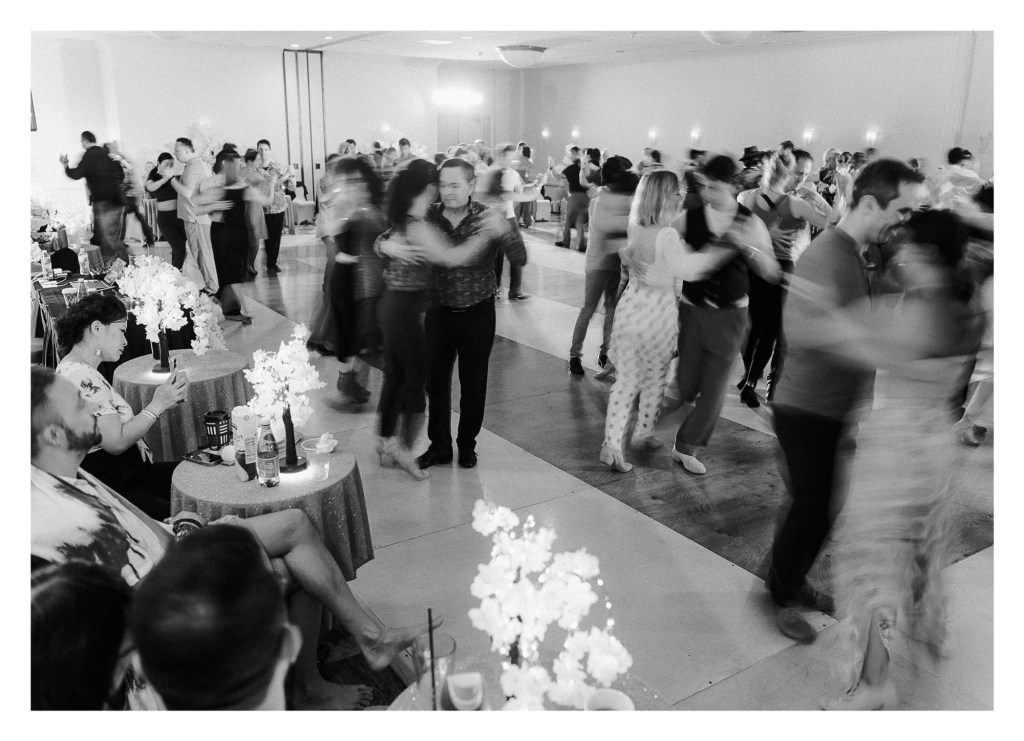
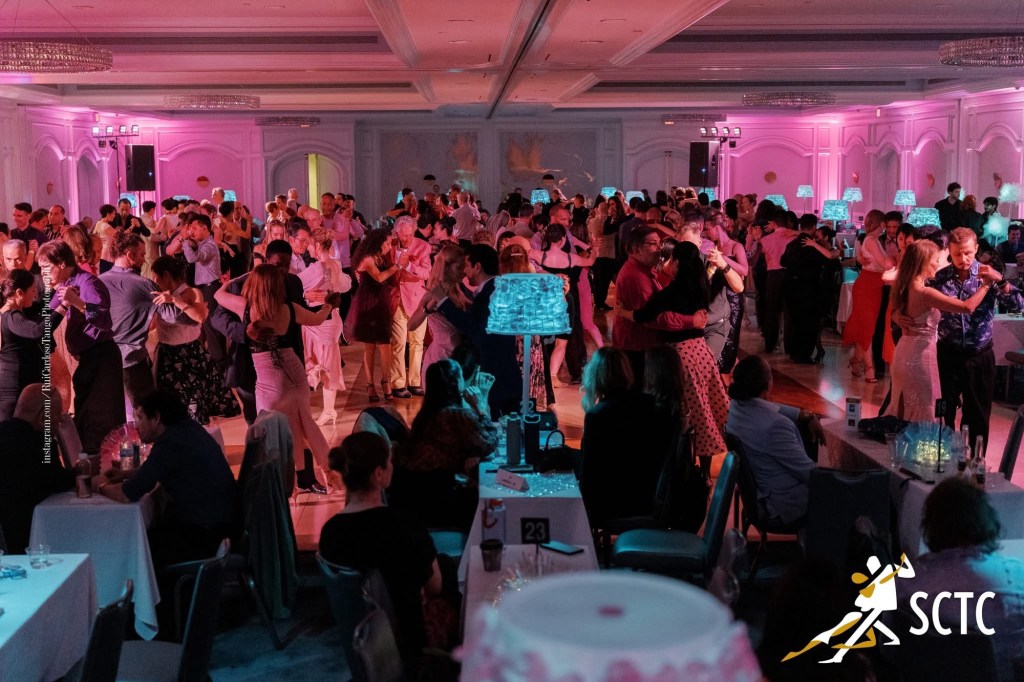
At the end of each day, there was a milonga, it was like a trip back in time. The music, the DJs, the performances… everything was magical. Not just the music, but also the people, the elegance on the dance floor. The atmosphere was incredible. When Sebas and Cynthia danced their tribute to the milonguero “Parejita,” who had just passed away at 95, my skin crawled and, for a change, my eyes watered.
All the performances were top-notch. Facundo and Vanesa’s show was a masterpiece, and Juan Malizia and Manuela Rossi’s dancing was hypnotic. It wasn’t just watching them dance; it was seeing art in motion. And on the final night, when all the maestros danced together, I felt a unique connection with every movement.
This was my first festival, and while I don’t have the authority to compare it to others, I can say with certainty that the SoCal Tango Festival changes lives. It’s a transformative experience. It’s worth every penny.
The Beauty That Hurts: Back Home:
The day I returned, the sky was gray, the emptiness felt empty… everything felt like a farewell. I walked with nostalgia, as if I were no longer in that magical world of tango.
However, at the hotel restaurant, I found a familiar face who invited me to join her and her friend for breakfast. She didn’t remember my name, but neither did I remember hers. Embarrassed, when she asked me my name again, she said, “Sorry, I’m just getting old and have dementia.” I smiled and said, “I don’t remember yours either.” The three of us re-introduced ourselves. Susan kept repeating that she had dementia, and her friend Thai, a little annoyed, told her, “It’s not true, don’t say that.” In my ignorance, as bold as ever, I began to explain to Susan why she shouldn’t keep telling herself that she has dementia, and I told her that her brain would eventually believe it.
It was a lovely breakfast because I love reading, and we ended up talking about brain functions. To my surprise, Thao is a neurologist and Susan Aree is a dentist. Thao Nguyen, the neurologist (I didn’t know their professions yet), looked at me and said exactly what you’re saying, and gave us a lecture on how our brain programs itself. She calls it self-fulfilling prophecies, meaning your brain ends up making what you keep saying come true. It was, without a doubt, the best breakfast and the best way to end my trip to the hotel where, in a way, I had had many epiphany moments.
On my first flight back, I arrived with very little time for my connection, tired because I’d been writing parts of this chronicle on the plane, some in my head and others on my phone. I ran a marathon for nothing, since the second flight was delayed. I went to the bathroom and, for a change, wrote more lines in my head about my emotional experience at the SoCal Tango Festival. When I landed, I realized I was walking in the wrong direction, away from the gate. I stopped dead in my tracks (another meme for anyone who noticed), turned around, and laughed to myself until I sat on the floor to wait for my flight.
In Phoenix, I was fortunate enough to meet Zilfe Fever, who, like me, had traveled from Sarasota to SoCal and shared many of my emotions. I felt the festival left me with something profound, something I’m still processing.
I wasn’t prepared for tango to confront me with so much. I felt vulnerable, exposed, human.
Art that connects isn’t always comforting. Sometimes, it only shows you what you still need to look at. And so it was. When I got home, with a mild case of the flu that I know my body had somatized, I felt like I’d left a part of myself behind, but I’d also taken with me a piece of everything I’d experienced. And as I continue to process this experience, I wonder if everything I felt at the festival, that unique connection, will ever be repeated. But for now, all I know is that it was an experience I’ll never forget.
El vuelo hacia lo desconocido SoCal (Southern California Tango Championship & Festival). Mi primer festival de tango, mi primera competencia, mi primera vez en California Estados Unidos. Nunca había competido en tango. Ni siquiera llevaba un año bailando. Pero algo dentro de mí decía que tenía que ir. Que esa experiencia tenía algo reservado para mí.
Sí, competí. Me atreví. Pero lo hice desde la ignorancia. Pido perdón —a los jurados, a los maestros, a los compañeros— porque no sabía lo que hacía… al menos no hasta que llegué a SoCal.
Todo comenzó dos semanas antes. Wook, un coreano con el que había bailado un par de tandas en Sarasota, me escribió por Facebook: ¿Quieres competir conmigo en un festival en la categoría de Tango de Pista Amateur?
Yo, que entendía “amateur” como “principiante”, le dije que sí casi sin pensarlo. Solo quedaban dos días para inscribirse. Mientras yo trataba de conseguir pasajes, él se encargaba de todo lo demás.
Después de comprar el tiquete, empecé a preguntar. Le escribí a Guada y Junior Cervilla, dos de los mejores bailarines de tango que conozco y quienes organizan una milonga al mes en Sarasota la cual fue mi primera milonga (a la que, por cierto, fui por primera vez con solo tres clases encima… me da pena admitirlo).
Guada me respondió: “El nivel allá es alto. No es como acá. Van los que van para el Mundial. Pero gózalo, va a ser una experiencia linda. Te va a gustar”.
Y ahí entendí que, una vez más, había saltado del avión sin preguntar si había paracaídas. Pero como digo siempre: mi mayor miedo ya pasó y al ridículo le tengo poco o ningún miedo.
Durante esas dos semanas, antes del festival, solo pude bailar con mi compañero unas cinco veces más. Wook me había propuesto bailar con él porque la mamá de su esposa se había enfermado y ahora ella debía cuidarla y no podía viajar. Wook, decidió buscar a alguien con quien participar en la categoría tango amateur. Supongo que le escribió a varias personas antes, pero justo dio conmigo —la que le dijo que sí sin pensarlo mucho.
Durante nuestra conversación me explicó su situación familiar y, además, me dijo algo que me tocó profundamente: “Ya estoy sobre los 55 años, esta puede ser mi primera y tal vez mi última oportunidad de competir.”
Eso me terminó de convencer. No había más que decir. Compré los tiquetes y me lancé a la aventura.
Días antes del festival, Wook enfermó. No pudimos practicar tanto como hubiéramos querido, y aun así, contra todo pronóstico, pasamos a la semifinal. Pero yo sabía —lo sentía— que los jurados podían ver cuando no hay conexión con tu pareja de baile. Faltaba comunicación y sincronía. Después del festival de tango California,, me tomé el tiempo de escuchar a mi partner con más atención. Veníamos de mundos completamente distintos.
A los ojos de los expertos, él sacrificaba el abrazo por el paso. Pero para él, ese abrazo cerrado, que a mí me parecía cálido y necesario, ya era en sí mismo un acto enorme de irrespeto contra su esposa. Un sacrificio cultural. ¿Y cómo explicarle el tango? Son palabras que no entiende, sonidos ajenos, una fonética completamente diferente.
Él escribe con figuras indescifrables para mí, y yo igual para él. Si no fuera por el inglés, no podríamos sostener una conversación. Y cuando habla en su idioma, para mi oído suena extraño e inarmónico.
Aun así, llegamos lejos. Y nos sentimos orgullosos. Probablemente no estemos hechos para bailar tango juntos, pero le agradezco de corazón haberme convocado a esta locura. Fue, sin duda, una de las experiencias más enriquecedoras de mi vida. El tango, aunque frágil, tejió un puente entre dos mundos.
Cruzando al otro lado
Para llegar al evento había que cruzar un camino que unía los dos hoteles, el mio estándar… cómodo, sí, pero sin mayor pretensión y el Hilton donde se llevaba a cabo SoCal Tango Festival California. A medida que caminaba hacia allá, el ambiente empezaba a transformarse. El camino era bonito, casi ceremonial. Uno sentía que estaba entrando a otro mundo: más elegante, más vibrante, más vivo.
Apenas puse un pie dentro del Hilton, lo sentí. Todo era distinto. Al fondo, un letrero anunciaba el festival Tango California. Había que caminar unos pasos más, girar a la derecha, luego a la izquierda… y ahí estaba: el corazón del evento.
Las mesas de inscripción. Allí entregaban las manillas, vendían entradas individuales para clases o milongas, y se sentía la energía de quienes habían hecho todo esto posible. Fue ahí donde conocí a Dionisio, el camarógrafo. Yo, como casi siempre, un poco perdida, lo miré sin saber bien a dónde ir. Él, sin dudar, me preguntó si necesitaba ayuda. Le dije que sí, que acababa de llegar. “¿Vienes para el festival?”, me preguntó. Cuando le dije que sí, me sonrió con una calidez muy especial: “Yo te llevo”. Me acompañó hasta la mesa y, por fin, recibí mi manilla.
Me había asegurado de comprar la entrada completa. Quería vivirlo todo. No vine a ver qué pasaba. Vine a estar en todo.
Ese primer día, después de instalarnos, fui a mercar con mi compañero. Fuimos a un supermercado coreano —una experiencia muy especial porque él también lo es— y descubrí sabores, texturas y olores completamente nuevos. Fue, curiosamente, lo único que vi de Irvine, porque fuera del festival, no exploré nada más. Solo vine al evento. Era mi primera vez en California, mi primera vez en un festival de tango, mi primera vez en una competencia… y además, ¡mi primer año bailando tango! Todo era una primera vez.
Mi primera clase fue con Manuela Rossi y Juan Malizia, especialistas en tango escenario. Son brillantes. Tomé dos clases con ellos ese día. Estaba perdida, claro, sin saber qué seguía ni a dónde ir. En una de esas pausas, mi partner tuvo que irse a competir y me dejó sola en uno de los salones… Fue entonces cuando llegó Clarisa Aragón.
Hice una clase solo para followers, para chicas. Me encantó. Aunque muchas veces me tocó hacer los ejercicios sola porque no éramos suficientes para emparejarnos, lo disfruté profundamente. En esa clase también conocí a Chris, parte del staff. Me notó, conectamos. Creo que le llamó la atención mi entrega. Desde ahí empezamos a hablar. Fue lindo. Empecé a crear vínculos reales con personas que, hasta entonces, eran perfectos desconocidos.
La clase de Clarisa fue especial. Ella tiene un ángel, una dulzura… una manera de enseñar que te envuelve.
Esa noche apoyé a mi compañero, Wook, y también a Andrés Bravo y Carolina Balmaseda, que ya sabía que competirían. Tengo el corazón con ellos desde hace mucho, los admiro. Pero también tenía el corazón con Jael Mantilla y Jesús Aranguren, dos chicos a quienes había conocido solo ocho días antes del evento porque Wook los había contratado por dos horas para ayudarnos a preparar para la competencia… y terminé compartiendo habitación con Jael. Viví el festival desde muchos ángulos: como aprendiz, como competidora ingenua, como amiga de una profesional que lo vivía todo con pasión.
Lo que no sabía era que ese viaje marcaría un antes y un después, no solo en mi baile, sino en mi forma de habitar el arte…
Competir sin conexión (cultural ni musical)
¿Cómo sobreviví a una competencia de tango Amateur con un compañero coreano sin una lengua en común?
Apenas nos conocemos, no hablábamos el mismo idioma. Teníamos referencias musicales distintas, educación corporal distinta. Y sin embargo…Pasamos a semifinales. Contra todo pronóstico.
Mi mente comenzó a escribir esto desde el momento en que llegué al evento. Soy consciente de que, en algún momento, o tal vez ya haya un meme circulando con mi reacción cuando, dejando los pelos en el alambrado (como decimos en mi país), mi compañero y yo pasamos a la semifinal. No lo podía creer… Esa soy yo mientras bailaba y vivía el festival escribía capítulos, párrafos y hasta páginas de historias, reflexiones y cuestionamientos a mí misma, que luego respondía. Y no solo en el tango, esto es, si aún no se ha notado, más profundo que una simple descripción del festival.
Pensé en mi papá, en mi vida, en cómo el ego nos juega malas pasadas, aunque sea por unos segundos, y no nos damos cuenta de lo heridos que estamos. Sentí y reflexioné sobre lo imperfecta que soy. Durante una clase, el día de la semifinal, me frustré con Wook durante la clase de musicalidad, dictada por Clarisa Aragón y Jonathan Saavedra. Como ambos escuchábamos la música de manera tan diferente, chocamos. Minutos después de acabar la clase, Clarisa, con ese carisma y mirada tan especial, se acercó a él y le explicó algo. Fue justo el momento en que teníamos que irnos. Salí del salón y ¡bum! Me dolió la rodilla, pero no la que siempre me duele, sino la que se supone que está mejor. En medio de esa frustración, sin saber cómo comunicarme con mi compañero de manera armónica y como equipo, paré afuera del salón —el mismo donde bailaríamos más tarde—, tomé agua y me pregunté: ¿por qué me duele la rodilla? Y la respuesta fue clara: eso es ego, Sara. Hay que bajarle al ego y entender que somos diferentes. Tal vez, en medio de mis reflexiones, mis caras eran chistosas, pero tuve momentos en los que parecía mirar al vacío cuando en realidad estaba escribiendo en mi mente, captando inspiración y fotografiando imágenes que ahora se traducen en palabras.
Para resumir esa reflexión: mi rodilla, como por arte de magia, dejó de doler. Tal vez mi ego somatizó. ¿Quise dejar a mi compañero y no presentarme con él porque no era como yo quería? Afortunadamente, reflexioné, me disculpé y seguimos adelante.
Así fui entendiendo cómo el cuerpo y la música se combinan y se vuelven arte. Pero la noche de la semifinal, esa misma noche en la que, evidentemente, no pasamos a la final, el ego nuevamente me dijo: “¿por qué no?” Pero había que decirle: “No te da”. Aquí no hay parejas improvisadas. Así funciona el tango: si no hay comunicación y conexión con tu pareja no está en la misma sintonía, el mensaje no se transmite claro ni limpio. Y eso era obvio entre mi compañero y yo, por lo que la sorpresa de no pasar a la siguiente ronda no fue tal.
Lo que entendí en ese momento es que conectar en el tango no solo se trata de sincronizarse con la música, sino también con tu pareja. Algunas veces logré sincronizarme con la musicalidad de mi líder, ya sea porque entendí los instrumentos que seguía o porque él, por tener más experiencia, ajustaba su señal para hacerme sentir bien. Pero, muchas veces, a pesar de estar perfectamente sincronizados con la música, faltaba algo, faltaba tango.
Aveces el corazón quiere bailar, pero el cuerpo no responde. Fue una lección de humildad. El arte no siempre es perfecto, pero siempre es honesto.
Cuando el arte te habla en tu idioma, lo único que puedes hacer… es escuchar
Entendí lo que no se puede explicar. Todos dicen que el amor y el arte no se explican, solo se sienten. ¿Pero cómo explicar el amor a un arte? Qué cosa más abstracta… aún escucho el tango en mi cabeza: el violín, el piano, todo mezclado.
Cuando escuché hablar a Vanesa Villalba y a Facundo Piñero fue como una caricia a mi alma…. Lloré toda la clase entendí que cuando la genialidad se junta con la perseverancia, el estudio constante y la búsqueda no solo de entender, aplicar sino de explicar transmitir y comunicar, buff, se hace magias.
Se me estalló la cabeza, hay un término coloquial en inglés para explicar lo que sentí: “blowing my mind” nunca entendí exactamente esa expresión hasta que hice las dos clases con Facundo y Vanesa, de hecho se suponía debía hacer una sola clase con ellos y luego ir a clase con Cynthia Palacios y Sebastián Bolivar porque como buena novata quería probarlo todo, verlos a todos; pero el corazón se me enganchó ahí con ellos.
Era como si hablaran mi idioma, como si cada palabra saliera de mi mente viajara a sus bocas y volviera a entrar de manera codificada y clara como si mi corazón y cerebro destellaran ondas, luces y ellos fueran capaces de codificarlo para luego explicármelo de manera humana en el lenguaje simple de las palabras además en los dos idiomas que hablo y en el orden en que los aprendí a hablar.
Pero el proceso era aún más complejo porque no solo era el lenguaje verbal cada movimiento hablaba, yo siempre he dicho que cuando uno baila los pies cantan , se comunican entre ellos como que uno habla y el otro responde así eran sus movimientos cuatro extremidades bajas mostrando el movimientos que no salían de ahí venían de cada célula, cada articulación, cada parte de esos dos maestros comunicaba magia, grandeza, simpleza, destreza pero sobretodo mucha limpieza…. Atención al detalle a lo simple.
Estaba sentada en el suelo, como muchos otros, mirando desde abajo. Fue una clase de ciencia y biomecánica explicada en poesía. ¿El resultado para mí? Lágrimas de emoción. Como quien mira una pintura que lo conmueve o escucha una canción que le toca el alma.
¿Quién dice que el arte no tiene ciencia? Esta gente aplica física pura… y la transforma en arte.
Al final, le dije a Andrés Bravo: “A ellos yo les pagaría todas las privadas posibles. Encontré mis maestros”. Y nos reímos.
Vanesa y Facundo son una mezcla entre el prodigio y el estudiante aplicado, un híbrido entre Mozart y Beethoven y, yo una estudiante primipara que solo puedo agradecerle a la vida por haberme puesto allí.
He llorado, he bailado, he dudado. Pero también he entendido algo profundo: el arte es hogar cuando se siente propio.
Un abrazo inesperado (y profundamente colombiano)
Reflexiones desde una milonga en Irvine. Cuando el cuerpo y el alma se sincronizan en el abrazo.
He sido muy afortunada durante mi primer año, pues vivo en una ciudad donde a pocos minutos tengo a Guada y a Junior Cervila y puedo, cada mes gozar en su milonga.
Además Anna Critchfield, una rusa amante del tango trae cada que puede a diferentes maestros para que dicten talleres y fue gracias ella, que pude bailar con “Dios”, como le dije yo por molestar a Claudio Villagra, baile una tanda con ese grande y quedé con la boca abierta. Eso fue solo unos días antes del festival, es una persona muy sencilla y por eso luego de llegar de SoCal pensé que tal vez un grande como él me podía ayudar a entender un poco lo que viví, así que le escribí lo siguiente:
“Hoy estoy muy sensible… He intentado escribir y describir todo esto en una especie de crónica personal para hacer catarsis (soy periodista). El punto es que, en ese festival, bailé con una persona con la que entendí lo que es la conexión en el tango. Y desde entonces me pregunto: ¿eso empieza a pasar más seguido una vez que ya lo viviste? ¿O es una cosa que ocurre solo cada mil años?
En medio de una milonga, un bailarín colombiano me invitó a bailar. No lo conocía. Pero cuando me abrazó, así es como se le llama a la posición en la dos personas se conectan para bailar, sentí una conexión familiar como cuando alguien te habla en tu idioma. No fue como bailar con un grande, como tú, que me dejó con la boca abierta por su técnica y presencia. Fue diferente. Fue como si hubiera bailado con mi otro yo. Con alguien que escucha e interpreta la música de la misma forma en que lo hago yo. Como si mis oídos y mi mente movieran nuestros cuerpos.
Pero lo más raro y hermoso fue la energía en el pecho. Sentí como si yo tuviera una linterna apagada adentro de mi pecho, y que, al empezar a bailar, se encendió. Era una luz cálida, una emoción que nacía en el centro del pecho y bajaba hacia la boca del estómago. La linterna siguió encendida aún cuando dejamos de bailar.
Me quedé con esa sensación encendida, sin entender cómo era posible que alguien pudiera escuchar y moverse casi exactamente como yo lo haría, para interpretar cada sonido. Fue como encontrar a mi alma gemela del el tango. Entendí la importancia del abrazo.
Le dije a ese colombiano que sentía como si escucháramos la música de la misma manera, prestándole atención a los mismos instrumentos, en los mismos momentos. No sé cómo describirlo, pero sí sé lo que sentí, y eso… nunca lo había sentido.
Él se sonrió y me dijo: “Eso se llama conexion”. Y fue como si otra pieza del rompecabezas se aclarara. Entendí lo que la gente quiere decir cuando habla de la conexión en el tango. Pero como aún soy nueva en esto del tango, me quedé con la pregunta: ¿cada cuánto se da ese tipo de conexión? ¿Volverá a pasarme con alguien más? ¿Siempre es mutuo?
La respuesta de Villagra fue un audio porque estaba manejando a la clase que él y su esposa dictan los martes en Miami y en el audio me decía: “que lindo eso, no es tan común y menos que sea mutua pero eso es el tango, trata de que no se pierda esa conexión, especialmente si es mutua.”
Aveces es mejor no saber:
Y al día siguiente, el colombiano con quien compartí tres tandas inolvidables, ganó el primer puesto en categoría Tango de Pista y Milonga, y el segundo lugar en Vals junto a su pareja. Sentí una alegría enorme por ellos. La verdad, el día de la final fue la primera vez que me fijé en él y su pareja como competidores, porque mi corazón estaba con otras dos parejas Carolina Balmaseda y Andrés Bravo, Jael Mantilla y Jesús Aranguren. No solo los estimo, también creo que son increíblemente buenos.
Ese día, aunque mi corazón seguía con Caro y Andrés, decidí abrir los ojos y observar a mi alrededor, ser un poco más objetiva. Fue entonces cuando vi la grandeza de Carlos Urrego y Ruth Hernandez. Otra vez sentí esa magia… como si los pies de ellos provocaran los sonidos que mis oídos más aprecian. Bailé con ellos sentada, con los ojos, con el alma. Pero también tenía la responsabilidad de grabar a mis amigos y apoyarlos. Fue una batalla entre titanes. Caro y Andrés tienen una presencia en el escenario que no se puede ignorar. Creo que nacieron para bailar juntos. Los vi hacerlo por primera vez cuando apenas decidían unirse como pareja. Sin ensayos ni más, ya eran uno. Ya eran espectáculo.
Esa noche, Carlos ganó. Y yo me alegré, porque Caro y Andrés también ganaron en la categoría escenario, con un despliegue de técnica, sentimiento y limpieza que solo ellos saben hacer..
Carlos me volvió a sacar a bailar pero ahora yo ya sabía quién era él. Ya se había convertido en campeón. Y sin embargo, bailó otra vez conmigo. Desde el momento en que nos paramos uno frente al otro, sin contacto, antes del abrazo… puff… volvió a pasar: un solo par de oídos con cuatro piernas para interpretar el sonido.
Me pregunto si volverá a pasar. Porque fue mágico.
A veces el tango no necesita técnica. Solo presencia, y un corazón dispuesto a latir al mismo compás.
¿Es técnica? ¿Es química? ¿Es acaso cultural? La conexión es ese misterio que nos obsesiona y nos sostiene en cada tanda.
Y quizá, como el arte, no se explica. Se siente. O no se siente. Y eso también está bien.
Al final creo que la verdadera conexión fue conmigo misma. Volví a ser niña creo que la conexión real fue con la Sara de 4 años que bailaba todo el día, la que solo quería ir a sus clases de danza folclórica y música. No sé cómo hice para acallarla por casi 15 años. Me llené de excusas después de un accidente que me dejó con una rodilla sentida, eso sumado a mis ocupaciones de adulta apagó a mi niña interior, mi niña cuya pasión era bailar.
Noches de milonga. El arte como espejo emocional.
Al final de cada jornada, había una milonga, era como un viaje en el tiempo. La música, los DJs, los performances… todo era mágico. No solo la música, sino también la gente, la elegancia en la pista. El ambiente era increíble. Cuando Sebas y Cynthia bailaron su tributo al “Parejita” milonguero quien acababa de fallecer a sus 95 años, se me erizó la piel y como para variar se me aguaron los ojos.
Todas las presentaciones eran espectáculos de primera categoría. El show de Facundo y Vanesa fue una obra maestra, y los bailes de Juan Malizia y Manuela Rossi, hipnóticos. No era solo verlos bailar; era ver arte en movimiento. Y la última noche, cuando todos los maestros bailaron juntos, sentí una conexión única con cada movimiento.
Este fue mi primer festival, y aunque no tengo la autoridad para compararlo con otros, puedo decir con certeza que SoCal Tango Festival cambia vidas. Es una experiencia transformadora. Vale cada centavo.
La belleza que duele: De vuelta a casa:
El día de mi regreso, estaba cielo gris, se sentía el vacío… todo se sintió como una despedida. Caminaba con nostalgia, como si ya no estuviera en ese mundo lleno de magia, de tango.
Sin embargo en el restaurante del hotel encontré una cara familiar quien me invitó a unirme a ella y a su amiga para el desayuno. Ella no recordaba mi nombre pero yo tampoco el suyo. En medio de su vergüenza al preguntarme mi nombre nuevamente dijo: “perdón es que ya tengo demencia por la edad”. Yo sonreí y le dije tranquila yo tampoco recuerdo el tuyo, y así nos presentamos entre las tres nuevamente. Susan seguía repitiendo que tenía demencia y su amiga Thai un poco disgustada le dijo no es cierto no digas eso. yo en medio de mi ignorancia muy atrevida como siempre, me metí a explicarle a Susan porque no debería continuar repitiéndose a sí misma que tiene demencia y le dije que su cerebro iba a terminar por creerlo.
Fue un desayuno lindo pues a mi me encanta leer y terminamos hablando de las funciones del cerebro y para mi sorpresa Thao es neuróloga y Susan Aree odontóloga. Así que Thao Nguyen, la neurologa (yo aun no sabia sus profesiones) me miró y dijo totalmente cierto lo que dices y nos dio una cátedra de cómo nuestro cerebro se programa lo llamo (self-fulfilling prophecies) profecías autocumplidas, es decir que tu cerebro termina haciendo realidad eso que tanto afirmas. Fue sin duda el mejor desayuno y la mejor manera de terminar mi viaje al hotel donde de cierta manera había tenido muchos momentos de Epifanía.
En mi primer vuelo de regreso, llegué con muy poco tiempo para la conexión, cansada porque venía escribiendo partes de esta crónica en el avión, algunas en mi mente y otras en mi teléfono. Corrí una maratón por nada, ya que el segundo vuelo se retrasó. Fui al baño y, como para variar, volví a escribir más líneas en mi mente sobre mi experiencia emocional en el SoCal Tango Festival. Cuando aterrizé, me di cuenta de que estaba caminando en la dirección equivocada, lejos de la puerta de embarque. Me detuve en seco (otro meme para quien lo haya notado), di la vuelta y me reí sola, hasta que me senté en el suelo para esperar el vuelo.
En Phoenix, Tuve la suerte de encontrarme Zilfe Fever quien como yo, había viajado desde Sarasota a SoCal compartí muchas de mis emociones. Sentí que el festival me dejó algo profundo, algo que aún sigo procesando.
No estaba preparada para que el tango me confrontara con tanto. Me vi vulnerable, expuesta, humana.
El arte que conecta no siempre consuela. A veces, solo te muestra lo que aún necesitas mirar. Y asi fue, Al llegar a casa, con una leve gripa que sé que mi cuerpo somatizó, sentí que había dejado atrás una parte de mí, pero también me llevé un pedazo de todo lo vivido. Y mientras sigo procesando esta experiencia, me pregunto si todo lo que sentí en el festival, esa conexión única, será algo que se repetirá alguna vez. Pero por ahora, lo único que sé es que esa fue una experiencia que jamás olvidaré.
The Florida housing market is undergoing a shift, and Bradenton is no exception. With increasing inventory, longer days on the market, and slight price declines, buyers are finding new opportunities in what was once a highly competitive seller’s market.
More Homes, More Choices
As of February 2025, Florida saw a record 168,717 properties listed for sale—a 40% increase from last year. Bradenton has followed this trend, with homes spending an average of 78 days on the market, up from 64 days in 2024. This means buyers have more options and negotiating power than they did even a few months ago.
Are Prices Dropping?
While Bradenton’s median home price remains strong at $429,900, it has dipped 4.5% compared to last year. This shift is especially noticeable in the 34203 and 34208 zip codes, where homes are selling in roughly 63 and 56 days, respectively. As competition cools, buyers may find opportunities for better deals, especially in suburban areas like Lakewood Ranch and Parrish, which are becoming increasingly attractive.
Should You Buy or Sell Now?
• For Buyers: Now is a great time to enter the market with more choices, less competition, and potential price negotiations.
• For Sellers: Pricing your home correctly and making strategic updates will be key to attracting buyers in this shifting market.
So, What Does This Mean for You?
Bradenton’s real estate market is shifting, which means new opportunities for both buyers and sellers. If you’re thinking about making a move, now might be the right time! Whether you’re looking for a great deal or trying to sell your home faster, a good strategy can make all the difference.
If you’re thinking about buying a home, you’ve probably asked yourself: When is the best time to buy a house?
The answer is simpler than you think: the best time to buy a home is when YOU decide you’re ready.
Is 2025 a Good Time to Buy a House?
Many buyers try to time the market, waiting for the “perfect opportunity.” But the truth is, there is no perfect time.
Think about other major life decisions:
• Were you 100% ready to meet the love of your life?
• Were you fully prepared for your first day of school?
• Did you feel completely confident before starting a new job?
Probably not. The key is to make a decision and prepare along the way.
Should I Wait for Home Prices to Drop?
One of the most common mistakes buyers make is waiting for prices or mortgage rates to drop. However, the real estate market is unpredictable, and what seems like a great deal today could become a missed opportunity tomorrow.
For example:
If home prices drop, but interest rates rise, your monthly payment could actually increase.
If you wait too long, you might miss out on special financing options or first-time homebuyer incentives.
The perfect house for you today may not be available when you’re finally “ready.”
Rather than trying to time the market, focus on your financial situation, housing needs, and long-term goals.
What Do I Need to Buy a House?
If you’re seriously considering buying a home, the most important thing is to get prepared. Here’s how:
Check your credit score and work on improving it if needed.
Save for your down payment and closing costs.
Consult with a real estate agent to explore your options.
Talk to a lender to get pre-approved for a mortgage.
As a real estate agent, my job is to guide you through the process and make it as smooth as possible. You don’t have to do it alone!
Final Thoughts: Is It the Right Time to Buy a Home?
If you’ve been asking yourself this question, it’s because your time to buy is now.
Don’t let fear or uncertainty hold you back. Opportunities are for those who take action.
If you’re ready to take the next step, let’s talk! I’m here to help you find the perfect home and make the buying process as easy as possible.
Si estás buscando comprar una casa, es probable que te hayas preguntado: ¿Cuándo es el mejor momento para comprar una vivienda?
La respuesta es más sencilla de lo que parece: el mejor momento para comprar una casa es cuando tú decides que estás listo.
¿Es un Buen Momento para Comprar Casa en 2025?
Muchos compradores intentan predecir el mercado inmobiliario, esperando la “mejor oportunidad”. Pero la realidad es que no hay un momento perfecto.
Así como no hay un día exacto en el que una persona se sienta 100% lista para tener hijos, casarse o cambiar de trabajo, lo mismo ocurre con la compra de una casa.
Si ya estás pensando en comprar, si has investigado opciones, si sientes la necesidad de dar el paso, ese es tu mejor momento para comprar vivienda.
¿Debo Esperar a que Bajen los Precios de las Casas?
Uno de los errores más comunes es esperar a que bajen los precios o las tasas de interés. Sin embargo, el mercado inmobiliario es impredecible, y lo que parece un buen momento hoy puede no serlo mañana.
Por ejemplo:
• Si los precios bajan, pero las tasas de interés suben, tu pago mensual puede ser más alto.
• Si esperas demasiado, podrías perder oportunidades de financiamiento o incentivos para compradores.
• La casa que te gusta hoy puede no estar disponible cuando decidas comprar.
En lugar de esperar el “momento perfecto”, lo ideal es evaluar tu situación personal, tu estabilidad financiera y tus necesidades de vivienda.
¿Qué Necesito para Comprar una Casa?
Si ya estás considerando comprar una propiedad, lo más importante es prepararte. Para eso, te recomiendo:
✅ Revisar tu crédito y mejorar tu puntaje si es necesario.
✅ Ahorrar para el pago inicial y los costos de cierre.
✅ Consultar con un agente de bienes raíces para conocer las opciones en tu área.
✅ Hablar con un prestamista para obtener una preaprobación hipotecaria.
Como agente de bienes raíces, mi trabajo es ayudarte en cada paso del proceso. No tienes que hacerlo solo/a.
Conclusión: ¿Es el Momento de Comprar una Casa?
Si ya te hiciste la pregunta, es porque el momento de comprar es ahora.
No te paralices esperando el mercado ideal. Las oportunidades son para quienes toman acción.
Si quieres comprar una casa, hablemos. Estoy aquí para ayudarte a dar ese gran paso y encontrar el hogar perfecto para ti.
📩 Contáctame hoy y comencemos tu proceso de compra. Sara@beyondrealtyfl.com
Comprar una casa es una de las decisiones financieras más importantes de tu vida, y en un mercado competitivo como el de Florida, contar con un agente de bienes raíces a tu lado puede marcar la diferencia. Aunque algunos compradores consideran hacerlo por su cuenta, trabajar con un agente experimentado ofrece ventajas significativas que pueden ahorrarte tiempo, dinero y estrés. Aquí te explicamos por qué contratar un agente de bienes raíces en Florida es una decisión inteligente.
1. Conocimiento Experto del Mercado
El mercado inmobiliario en Florida varía según la ubicación, desde áreas metropolitanas de rápido crecimiento hasta tranquilas ciudades costeras. Un agente experimentado comprende las tendencias locales, el valor de las propiedades y qué zonas tienen mayor potencial de inversión. Su conocimiento te ayuda a encontrar la casa ideal al mejor precio.
2. Acceso a Propiedades Fuera del Mercado y Nuevos Listados
No todas las casas aparecen en los principales sitios web de bienes raíces. Muchas propiedades se venden a través de redes de agentes antes de ser anunciadas públicamente. Al trabajar con un agente, tienes acceso a listados exclusivos, lo que te da una ventaja competitiva para encontrar la casa perfecta.
3. Habilidad para Negociar un Mejor Precio
Comprar una casa no es solo hacer una oferta, sino también asegurar el mejor trato posible. Un buen agente negocia en tu nombre para obtener el mejor precio, solicitar reparaciones necesarias e incluso conseguir ayuda con los costos de cierre. Su experiencia puede ahorrarte miles de dólares.
4. Acompañamiento Durante Todo el Proceso de Compra
Desde hacer una oferta hasta el cierre, comprar una casa implica muchos pasos, documentos y plazos. Un agente se asegura de que sigas el proceso correctamente, evites errores comunes y comprendas cada etapa, reduciendo el estrés y la incertidumbre.
5. Conocimiento de las Leyes de Bienes Raíces en Florida
Los contratos de bienes raíces en Florida incluyen términos, contingencias y requisitos de divulgación específicos. Un agente te ayuda a navegar por estos aspectos legales, garantizando que tus derechos estén protegidos y que entiendas completamente el contrato antes de firmarlo.
6. No Tiene Costo para el Comprador
Uno de los mayores beneficios de trabajar con un agente de bienes raíces como comprador es que sus servicios generalmente no tienen un costo directo para ti. En la mayoría de las transacciones, el vendedor paga la comisión tanto del agente de listado como del agente del comprador, lo que significa que obtienes representación profesional sin cargos adicionales.
7. Asistencia con Inspecciones y Evaluación de Riesgos
El clima de Florida presenta desafíos únicos para los propietarios de viviendas, como huracanes, zonas de inundación y costos de seguro elevados. Un agente con experiencia te ayudará a coordinar inspecciones, evaluar riesgos potenciales y asegurarte de tomar una decisión informada antes de comprar una propiedad.
8. Un Proceso de Cierre sin Complicaciones
El cierre de una compra de vivienda involucra múltiples partes, incluidos prestamistas, compañías de títulos y abogados. Tu agente se encargará de coordinar con todos ellos, gestionar los detalles de última hora y asegurarse de que todo se desarrolle sin problemas, permitiéndote concentrarte en la emoción de mudarte a tu nuevo hogar.
Conclusión
Comprar una casa es una gran inversión, y tener un agente de bienes raíces de confianza a tu lado te garantiza obtener el mejor trato y evitar errores costosos. Desde su conocimiento del mercado hasta su habilidad para negociar contratos, un agente brinda un apoyo invaluable durante todo el proceso de compra. Y lo mejor de todo es que sus servicios generalmente no representan un costo para los compradores.
¿Listo para encontrar tu hogar ideal en Florida?
Si estás buscando comprar una casa y quieres un proceso fácil, seguro y sin complicaciones, ¡estoy aquí para ayudarte! Contáctame hoy mismo y hagamos realidad tu sueño de tener casa propia.
Buying a home is one of the biggest financial decisions you’ll ever make, and in a competitive market like Florida, having a real estate agent by your side can make all the difference. While some buyers consider going solo, working with a knowledgeable agent provides significant advantages that can save time, money, and stress. Here’s why hiring a real estate agent in Florida is a smart decision for buyers.
1. Expert Market Knowledge
Florida’s real estate market varies greatly depending on location, from fast-growing metro areas to quiet beach towns. A skilled agent understands local trends, property values, and which areas have the best investment potential. Their expertise helps you find the right home at the right price.
2. Access to Off-Market and New Listings
Not all homes are publicly listed on major real estate websites. Many properties sell through agent networks before they even hit the market. By working with an agent, you gain access to exclusive listings, giving you a competitive advantage in finding your dream home.
3. Strong Negotiation Skills
Buying a home isn’t just about making an offer—it’s about securing the best deal. A good real estate agent negotiates on your behalf, helping you get a fair price, request necessary repairs, and even negotiate closing cost assistance. Their experience can save you thousands in the long run.
4. Guidance Through the Buying Process
From making an offer to closing day, purchasing a home involves multiple steps, paperwork, and deadlines. An agent ensures you stay on track, avoid common pitfalls, and understand every part of the process, reducing stress and confusion.
5. Understanding of Florida’s Real Estate Laws
Real estate contracts in Florida come with specific terms, contingencies, and disclosure requirements. An agent helps you navigate these legalities, ensuring that your rights are protected and that you fully understand the contract before signing.
6. No Cost to You as a Buyer
One of the biggest benefits of working with a real estate agent as a buyer is that their services typically come at no direct cost to you. In most transactions, the seller pays the commission for both their listing agent and your buyer’s agent, meaning you get professional representation without extra fees.
7. Assistance with Inspections and Due Diligence
Florida’s unique climate presents homeownership challenges such as hurricanes, flood zones, and high insurance costs. A knowledgeable agent will help you arrange home inspections, review potential risks, and ensure you’re making a well-informed decision before committing to a property.
8. A Smooth Closing Process
Closing on a home involves multiple parties, including lenders, title companies, and attorneys. Your agent will coordinate with all of them, handle last-minute details, and ensure that everything runs smoothly, allowing you to focus on the excitement of moving into your new home.
Final Thoughts
Buying a home is a major investment, and having a trusted real estate agent by your side ensures you get the best deal while avoiding costly mistakes. From market expertise to contract negotiations, an agent provides invaluable support throughout the entire home-buying process. Best of all, their services typically cost buyers nothing out of pocket.
If you’re considering buying a home in Florida, working with an experienced real estate agent isn’t just a good idea—it’s a smart move.
Why Having a Real Estate Agent in Florida Is a Smart Move for Buyers
Buying a home is one of the biggest financial decisions you’ll ever make, and in a competitive market like Florida, having a real estate agent by your side can make all the difference. While some buyers consider going solo, working with a knowledgeable agent provides significant advantages that can save time, money, and stress. Here’s why hiring a real estate agent in Florida is a smart decision for buyers.
1. Expert Market Knowledge
Florida’s real estate market varies greatly depending on location, from fast-growing metro areas to quiet beach towns. A skilled agent understands local trends, property values, and which areas have the best investment potential. Their expertise helps you find the right home at the right price.
2. Access to Off-Market and New Listings
Not all homes are publicly listed on major real estate websites. Many properties sell through agent networks before they even hit the market. By working with an agent, you gain access to exclusive listings, giving you a competitive advantage in finding your dream home.
3. Strong Negotiation Skills
Buying a home isn’t just about making an offer—it’s about securing the best deal. A good real estate agent negotiates on your behalf, helping you get a fair price, request necessary repairs, and even negotiate closing cost assistance. Their experience can save you thousands in the long run.
4. Guidance Through the Buying Process
From making an offer to closing day, purchasing a home involves multiple steps, paperwork, and deadlines. An agent ensures you stay on track, avoid common pitfalls, and understand every part of the process, reducing stress and confusion.
5. Understanding of Florida’s Real Estate Laws
Real estate contracts in Florida come with specific terms, contingencies, and disclosure requirements. An agent helps you navigate these legalities, ensuring that your rights are protected and that you fully understand the contract before signing.
6. No Cost to You as a Buyer
One of the biggest benefits of working with a real estate agent as a buyer is that their services typically come at no direct cost to you. In most transactions, the seller pays the commission for both their listing agent and your buyer’s agent, meaning you get professional representation without extra fees.
7. Assistance with Inspections and Due Diligence
Florida’s unique climate presents homeownership challenges such as hurricanes, flood zones, and high insurance costs. A knowledgeable agent will help you arrange home inspections, review potential risks, and ensure you’re making a well-informed decision before committing to a property.
8. A Smooth Closing Process
Closing on a home involves multiple parties, including lenders, title companies, and attorneys. Your agent will coordinate with all of them, handle last-minute details, and ensure that everything runs smoothly, allowing you to focus on the excitement of moving into your new home.
Final Thoughts
Buying a home is a major investment, and having a trusted real estate agent by your side ensures you get the best deal while avoiding costly mistakes. From market expertise to contract negotiations, an agent provides invaluable support throughout the entire home-buying process. Best of all, their services typically cost buyers nothing out of pocket.
If you’re considering buying a home in Florida, working with an experienced real estate agent isn’t just a good idea—it’s a smart move.
Un open house bien organizado puede atraer a múltiples compradores y generar ofertas rápidamente. La clave está en crear un ambiente acogedor donde los visitantes puedan imaginarse viviendo y disfrutando del espacio. Sigue estos cinco pasos para garantizar el éxito de tu evento:
1. Organiza un Open House Exclusivo para Agentes
Antes de abrirlo al público, invita a agentes y corredores de bienes raíces. Esto genera interés y puede hacer que recomienden la propiedad a sus clientes, aumentando la posibilidad de recibir ofertas.
2. Elige la Fecha y Hora Perfecta
Selecciona un día y horario estratégicos para atraer más compradores:
• Fines de semana: ideales para la mayoría de los compradores.
• Tardes entre semana: pueden funcionar mejor en mercados donde los compradores tienen agendas ocupadas los fines de semana.
Consulta con tu agente cuál es el mejor momento en tu área.
3. Promociona el Evento
Asegúrate de que la mayor cantidad de personas se enteren de tu open house usando múltiples canales:
• Publica el evento en la MLS.
• Comparte en redes sociales y grupos comunitarios.
• Coloca anuncios en cafés, supermercados y otros puntos clave.
• Usa señalización visible el día del evento.
4. Despeja y Despersonaliza los Espacios
Para que los compradores se visualicen en la casa, elimina objetos personales y muebles innecesarios. Un espacio limpio y bien organizado crea una mejor impresión y hace que la casa luzca más amplia.
5. Reorganiza el Espacio para Mejorar el Flujo
Después de despejar, reacomoda los muebles para crear un ambiente acogedor y funcional. Si es necesario, consulta a tu agente o a un especialista en home staging para maximizar el atractivo de la propiedad.
Con la planificación adecuada, tu open house puede convertirse en un evento memorable que atraiga al comprador ideal. ¡Buena suerte!