Cuarta y última parte de una serie sobre mi experiencia en el SoCal Tango Festival 2026.
El último día del festival no empezó fácil.
Pasaron cosas.
Cosas personales.
Cosas que no eran solo mías.
Cosas que, inevitablemente, me afectaban.
Y aun así…
Decidí no pelear.
Decidí no engancharme.
Decidí quedarme.
Quedarme en el momento.
Quedarme en el proceso.
Quedarme en lo que sí importa.
Porque hubiera sido muy fácil dejar que todo eso arruinara la noche.
Hubiera sido muy fácil cerrarme.
Irme.
Desconectarme.
Pero no lo hice.
Y creo que esa fue la verdadera diferencia.
Esa noche, a pesar de todo…
Bailé.
Pero no bailé igual.
Bailé más tranquila.
Más presente.
Más conectada.
No porque todo estuviera perfecto.
Sino porque yo estaba diferente.
Ya no estaba tan pendiente de quién miraba.
Ya no estaba tan pendiente de lo que podían pensar.
Ya no estaba tan pendiente de si lo estaba haciendo bien o mal.
Simplemente estaba ahí.
Y por primera vez en todo el festival…
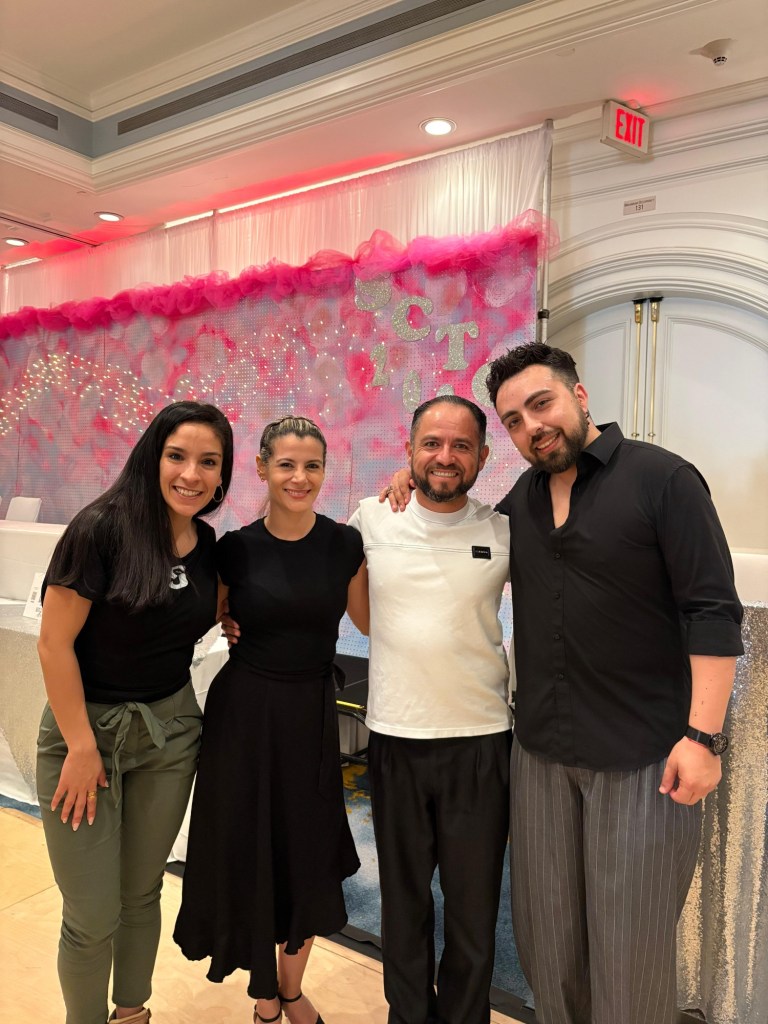
Me la disfruté de verdad.
No perfecta.
No impecable.
Pero real.
Y entendí algo que, tal vez, era lo que tenía que entender todo este tiempo.
Que al final…
No se trata de los demás.
No se trata de las miradas.
No se trata de las expectativas.
Se trata de uno.
De lo que uno decide hacer con lo que siente.
De si uno alimenta el miedo…
o lo deja ir.
Porque el miedo va a estar.
La presión va a estar.
Las miradas van a estar.
Pero también está la decisión.
Y esa noche, yo decidí.
Decidí no dejarme llevar por eso.
Decidí confiar.
Decidí bailar.
Y eso cambió todo.
No el entorno.
No las personas.
No las circunstancias.
A mí.
Y con eso fue suficiente.
Cerré el festival entendiendo que no tengo que ser perfecta.
Que no tengo que estar lista.
Que no tengo que demostrar nada.
Otra cosa que me impactó profundamente —y que a los ojos de muchos podría parecer insignificante— fue lo que vi el último día del festival en la tarde, durante los finales de la competencia.
Presentaron un grupo de tango coreográfico. Eran estudiantes. A la mayoría se les notaba que llevaban poco tiempo, pero había algo muy lindo en lo que estaban construyendo.
Y en otro momento de mi vida, tal vez no lo habría valorado. Tal vez habría visto solo una capa superficial, como cuando uno apenas empieza y solo admira a los grandes.
Pero después de todo lo que viví en este festival… algo cambió.
Después del miedo, de la frustración, del proceso… empecé a ver distinto.
Y los vi.
Vi el proceso. Vi el esfuerzo. Vi el inicio.
Y me emocioné.
Porque entendí algo más profundo: que esto también es tango.
No la perfección. No solo los grandes escenarios. Sino el inicio.
Lloré.
Lloré porque por fin entendí lo que mucha gente quizá no vio ese día.
Vi futuro.
Vi potencial.
Vi historias que apenas están comenzando.
Y sentí algo muy fuerte: orgullo ajeno, empatía… y gratitud por haber llegado a entenderlo así.
Le susurré algo a Carlos Urrego, porque sé que él también lo ve.
“Así es como uno debería empezar…”
Y se me salieron las lágrimas.
Tal vez porque me hubiera gustado haber entendido esto antes.
Pero todos los procesos son distintos.
Y todas las historias son únicas.
Y ahí entendí algo que quizás resume todo este viaje:
No se trata solo de llegar lejos. Se trata de aprender a ver.
Como dice Con la frente marchita, en la versión que más me gusta, interpretada por Adriana Varela —una cantante de tango argentina—, aunque originalmente es de Joaquín Sabina, un cantautor español influenciado profundamente por el universo del tango:
“No hay nostalgia peor que añorar lo que nunca, jamás, sucedió”.
Solo tengo que seguir.
Seguir bailando.
Seguir aprendiendo.
Seguir atravesando el proceso.
Porque si algo me dejó este festival…
Es eso.
Quedarme.
🔗 Leer también (serie completa)
Competir sin conexión: mi primera vez en un festival de tango en California
Entrada 2: Bailar con miedo: lo que nadie te dice del tango
Entrada 3: Cuando el proceso duele: frustración, comparación y verdad
ENGLISH VERSION
Series: When art confronts you with yourself
Choosing to Stay: What This Festival Really Left Me
Final part of a series about my experience at the SoCal Tango Festival.
The last day of the festival didn’t start easy.
Things happened.
Personal things.
Things that weren’t just mine.
Things that inevitably affected me.
And still…
I chose not to fight.
I chose not to react.
I chose to stay.
To stay in the moment.
To stay in the process.
To stay in what actually matters.
Because it would have been very easy to let all of that ruin the night.
It would have been easy to shut down.
To leave.
To disconnect.
But I didn’t.
And I think that was the real difference.
That night, despite everything…
I danced.
But not the same way.
I danced more calmly.
More present.
More connected.
Not because everything was perfect.
But because I was different.
I wasn’t as focused on who was watching.
I wasn’t as focused on what people might think.
I wasn’t as focused on whether I was doing it right or wrong.
I was just there.
And for the first time during the whole festival…
I truly enjoyed it.
Not perfect.
Not flawless.
But real.
And I understood something that maybe I was meant to understand all along.
In the end…
It’s not about others.
It’s not about the looks.
It’s not about expectations.
It’s about you.
About what you choose to do with what you feel.
Whether you feed the fear…
or let it go.
Because the fear will be there.
The pressure will be there.
The eyes will be there.
But so is the choice.
And that night, I chose.
I chose not to be carried by that.
I chose to trust.
I chose to dance.
And that changed everything.
Not the environment.
Not the people.
Not the circumstances.
Me.
And that was enough.
I closed the festival understanding that I don’t have to be perfect.
That I don’t have to be ready.
That I don’t have to prove anything.
Another thing that deeply impacted me — and that might seem insignificant to many people — was what I saw on the last day of the festival in the afternoon, during the competition finals.
They presented a tango choreographic group. They were students. Most of them were clearly beginners, but there was something very beautiful in what they were building.
And at another point in my life, I might not have appreciated it. I might have only seen a superficial layer, like when you are just starting and only admire the great masters.
But after everything I lived through in this festival… something changed.
After the fear, the frustration, the process… I started to see differently.
And I saw them.
I saw the process. I saw the effort. I saw the beginning.
And I got emotional.
Because I understood something deeper: this is also tango.
Not perfection. Not only the big stages. But the beginning.
I cried.
I cried because, for the first time, I understood what many people might not have seen that night.
I saw the future.
I saw potential.
I saw stories that are just beginning.
And I felt something very strong: admiration for others, empathy… and gratitude for having reached this way of seeing.
I whispered something to Carlos Urrego, because I know he sees it too.
“This is how one should start…”
And I started crying.
Maybe because I wish I had understood this earlier.
But every process is different.
And every story is unique.
And in that moment I understood something that perhaps summarizes this whole journey:
It’s not just about getting far. It’s about learning how to see.
As Con la frente marchita says, in the version I love the most, performed by Adriana Varela — an Argentine tango singer — although it was originally written by Joaquín Sabina, a Spanish songwriter deeply influenced by the world of tango:
“There is no worse nostalgia than longing for something that never, ever happened.”
I just have to continue.
To keep dancing.
To keep learning.
To keep going through the process.
Because if there’s something this festival gave me…
It’s this.
To stay.
🔗 Read also (full series)
Competing Without & Connection: My First Tango Festival in California
Part 2: Dancing with Fear: What No One Tells You About Tango
Part 3: When the Process Hurts: Frustration, Comparison, and Truth
 Sara Rengifo